
Trapped by Land, Air, and Sea: Children’s Mental Health in Gaza
Media
Image
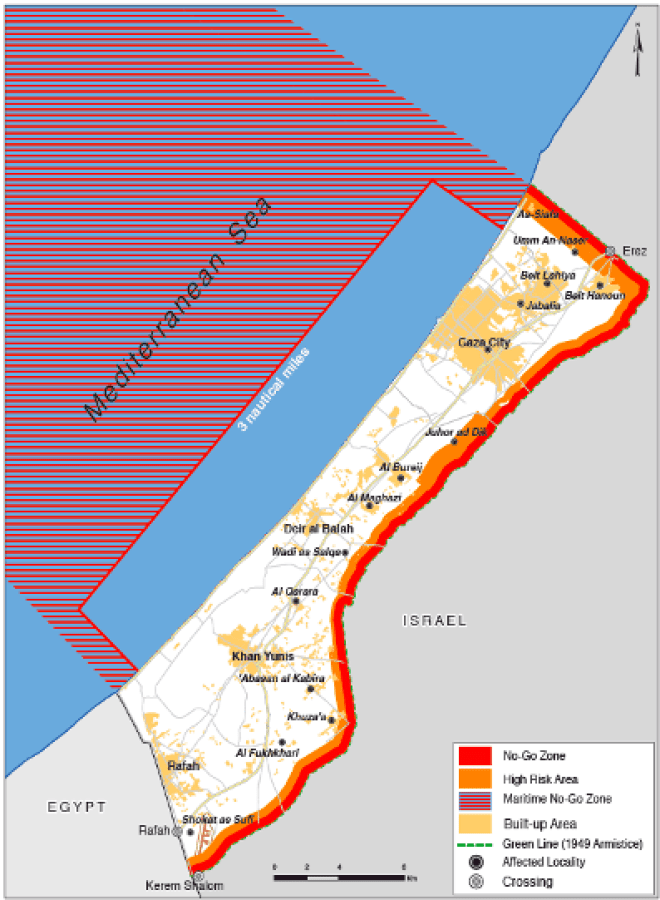
Media description
The blockade on Gaza. Source: United Nations (n.d.)Blog content
By Leen Farouki, Refugees, Health and Humanitarian Action course student, SPS 2021-2022 academic year
International Rights and Laws
Living in what has been described as “the world’s largest open-air prison” (Høvring, 2018) cannot be doing any favours for anyone’s health and wellbeing. Living in what has been described as “the world’s largest open-air prison” (Høvring, 2018) cannot be doing any favours for anyone’s health and wellbeing.
One might assume that under international human rights law, the people of Gaza are protected in relation to both physical and mental health. Target 3.4 of the United Nations’ (UN) Sustainable Development Goals aims to promote mental health and wellbeing and Target 3.8 aims to ensure access to healthcare services (UN, 2015). However, it can be argued that neither aim is even approaching success in Gaza.
the UN’s 1948 Universal Declarations on Human Rights, Article 25 asserts that “Everyone has the right to a standard of living adequate for the health and well-being” (UNDHR, 1948). To this day, this is not true for those in Gaza.
One might also wonder why the signatories of the 1951 Refugee Convention have not taken action to ensure refugee rights in Gaza. This is due to a loophole of sorts: the Convention does not apply to refugees who receive protection or benefits from agencies other than UNHCR - meaning that Palestinians, who receive aid from the United Nations Relief and Works Agency for Palestine Refugees in the Near East (UNRWA), are not ensured rights by the Convention (Bastaki, 2017). Their exclusion from the Convention is discriminatory and has largely barred them from social protection.
So, how have the circumstances in Gaza and the lack of international action impacted health and wellbeing? Let us consider a particular case: children’s mental health following the May 2021 conflict.
Children’s Mental Health
Out of 2.1 million Gazans, around 1.4 million are registered refugees (UNRWA, 2021a) and 42.5% are under 14 years old (Index Mundi, 2021). Considering Gaza’s strikingly young population, frequent attacks on the region, and the land, air, and sea blockade by Israel and Egypt (Høvring, 2018), it is no surprise that access to humanitarian aid for children’s mental health is a matter of prominent concern.
Since much of the population consists of children, young Gazans are disproportionately affected by the violence surrounding them. Depression, anxiety, trauma, and general distress are common (UNRWA, N.D.). These problems were exacerbated by the most recent major conflict, with children displaying higher levels of fear, constant shaking, and enuresis (Save the Children, 2021). But the events of May 2021 were not standalone occurrences; their psychological effects build onto years and decades of such experiences. Thus, the need for children’s mental healthcare increased in the summer of 2021.
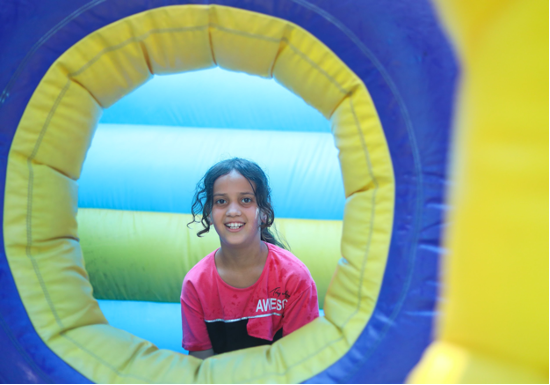
Following the conflict, UNRWA ran summer camps consisting of artistic and athletic activities to promote psychological wellbeing and reduce distress and trauma symptoms. Of 150,000 children involved, 98,500 required further mental healthcare as they had severe reactions to the attacks (UNRWA, 2021b). It is a pity that programmes like this are necessary, and that they are not even enough to address the mental damage sustained by these children.
These children should have never faced the things they did in the first place. How can humanitarian organisations provide for a community that is unprotected by international actors and agreements and constantly re-traumatised in an ongoing conflict? Can we truly consider interventions a success when the participants will most likely be re-traumatised?
Why Humanitarian Aid is Falling Short
The state of humanitarian aid in the region is concerning in general, let alone in its ability to provide mental healthcare to children. Under the blockade, and due to active calls by the Israeli Government to end international funding to UNRWA (Lazaroff, 2021), it is particularly difficult to coordinate interventions. On 18 May 2021, the eighth day of the conflict, UNRWA released a call to the Government of Israel to allow humanitarian workers and supplies into Gaza (UNRWA, 2021c). The Israeli Government denied the allegations that they were blocking aid (The Times of Israel, 2021), refused to cooperate with a UNHRC investigation, and criticised further aid efforts by the WHO as politicisation (Zarocostas, 2021).
Humanitarian aid providing healthcare to civilians must not be portrayed as politically driven because its intention is civilian wellbeing. Had the population had access to not only mental health care, but general health care, food, clean water, medication, and provisional shelter that UNRWA and the WHO sought to supply, perhaps the distress and trauma that followed the conflict may have been reduced.
This emphasises the persisting relevance of a call to action from 12 years prior, of which not many have taken heed. In 2009, The Lancet published an editorial condemning the victimisation of Gazan civilians and criticising the Israeli army for breaking international humanitarian law by destroying health services and not evacuating or providing aid to Gazan civilians. Moreover, the editorial criticises the inaction of national organisations, medical and otherwise, deeming them essentially complicit in perpetuating physical and mental harm (The Lancet, 2009).
This editorial was met with some support, but also political outrage. However, The Lancet in no way denied Israeli losses nor did it even mention the imbalance of power between Gaza and Israel. This is not a question of politics, but civilian rights and access to care. Ten years later, a BMJ Global Health commentary criticised the global health community in particular for not acting on The Lancet call to action (Mills et al. 2019). No considerable measures have been taken as of now in 2022.
The international community, humanitarian and medical groups and world leaders, must ensure that mental healthcare is available in Gaza. War crimes cannot be swept under the rug any longer. Defamation attempts towards humanitarian aid agencies trying to provide much-needed care must be stopped. International humanitarian laws and policies must be adequately enforced. Furthermore, if we can stop the damage from happening— if we can stop the traumatisation of hundreds of thousands of children to begin with— there will be no need for this type of humanitarian aid. There will be no need for the band-aid-on-a-bullet-wound status quo in Gaza.
Reference List
Bastaki, J. (2017). The legacy of the 1951 refugee convention and Palestinian refugees: multiple displacements, multiple exclusions. [Online] Available at: https://doi.org/10.15779/Z38DJ58G2P
Høvring, R. (2018) Gaza: The world’s largest open-air prison. Norwegian Refugee Council. [Online] Available at: https://www.nrc.no/news/2018/april/gaza-the-worlds-largest-open-air-prison/ (Accessed: 26 February 2022).
Index Mundi (2021). Gaza Strip Demographics Profile. [Online] Available at: https://www.indexmundi.com/gaza_strip/demographics_profile.html
Lazaroff, T. (2021). Israel slams Biden's resumption of UNRWA funding for Palestinians. [Online] Available at: https://www.jpost.com/breaking-news/us- to-restore-about-150-million-in-aid-to-palestinians-664413 (Accessed: 26 February 2022).
Mills, Gilbert, M., & Wispelwey, B. (2019). Gaza’s Great March of Return: humanitarian emergency and the silence of international health professionals. BMJ Global Health, 4(3), e001673–e001673. https://doi.org/10.1136/bmjgh-2019-001673
OCHA. (2021) Protection of Civilians Report. [Online] Available at: https://www.ochaopt.org/poc/24-31-may-2021 (Accessed: 26 February 2022).
Save the Children. (2021) Children in Gaza-conflict will suffer for years to come. [Online] Available at: https://www.savethechildren.org.uk/news/media-centre/press-releases/children-in-gaza-conflict-will-suffer-for-years-to-come (Accessed: 26 February 2022).
The Lancet. (2009) ‘The medical conditions in Gaza.’ The Lancet (British Edition), 373(9659), 186–186. https://doi.org/10.1016/S0140-6736(09)60049-0
The Times of Israel. (2021) Israel blasts UNRWA for claiming it’s blocking aid to Gaza: ‘Simply a lie’. [Online] Available at: https://www.timesofisrael.com/liveblog_entry/israel-blasts-unrwa-for-claiming-its-blocking-aid-to-gaza-simply-a-lie/ (Accessed: 26 February 2022).
UN. (2015) Sustainable Development Goals. [Online] Available at: https://sdgs.un.org/goals/goal3 (Accessed: 26 February 2022). UN. (n.d.) [Map of the Gaza blockade] Available at: https://www.un.org/unispal/humanitarian-situation-in-the-gaza-strip-fast-facts-ocha-factsheet/ (Accessed: 26 February 2022).
UNDHR. (1949) The Universal Declaration of Human Rights. [Online] Available at:
https://www.un.org/en/about-us/universal-declaration-of-human-rights (Accessed: 26 February 2022).
UNRWA. (2021a) Where we work. [Online] Available at: https://www.unrwa.org/where-we-work/gaza-strip (Accessed: 26 February 2022).
UNRWA. (2021b) World mental health day 2021 – Palestine refugee youth helping heal their communities, one camp at a time. [Online] Available at: https://www.unrwa.org/newsroom/features/world-mental-health-day-2021- %E2%80%93-palestine-refugee-youth-helping-heal-their#_ftn1 (Accessed: 26 February 2022).
UNRWA. (2021c) UNRWA urgently calls on Israel to enable access to Gaza. [Online] Available at: https://www.unrwa.org/newsroom/press-releases/unrwa-urgently-calls-israel-enable-access-gaza (Accessed: 26 February 2022).
UNRWA. (2021d) [Girl participating in summer camp activities] Available at: https://twitter.com/unrwa/status/1413415126217134081 (Accessed: 26 February 2022).
UNRWA. (n.d.) (2014) Gaza Conflict. [Online] Available at: https://www.unrwa.org/2014-gaza-conflict (Accessed: 26 February 2022).
Zarocostas, J. (2021) ‘Aid agencies escalate Gaza relief effort.’ The Lancet (British Edition), 397(10290), 2136–2136. https://doi.org/10.1016/S0140-6736(21)01283-6