
Temporary Marriages: Freedom or Exploitation? The Risk of Sexual Coercion of Syrian Refugee Girls in the Jordanian Context
Media
Image
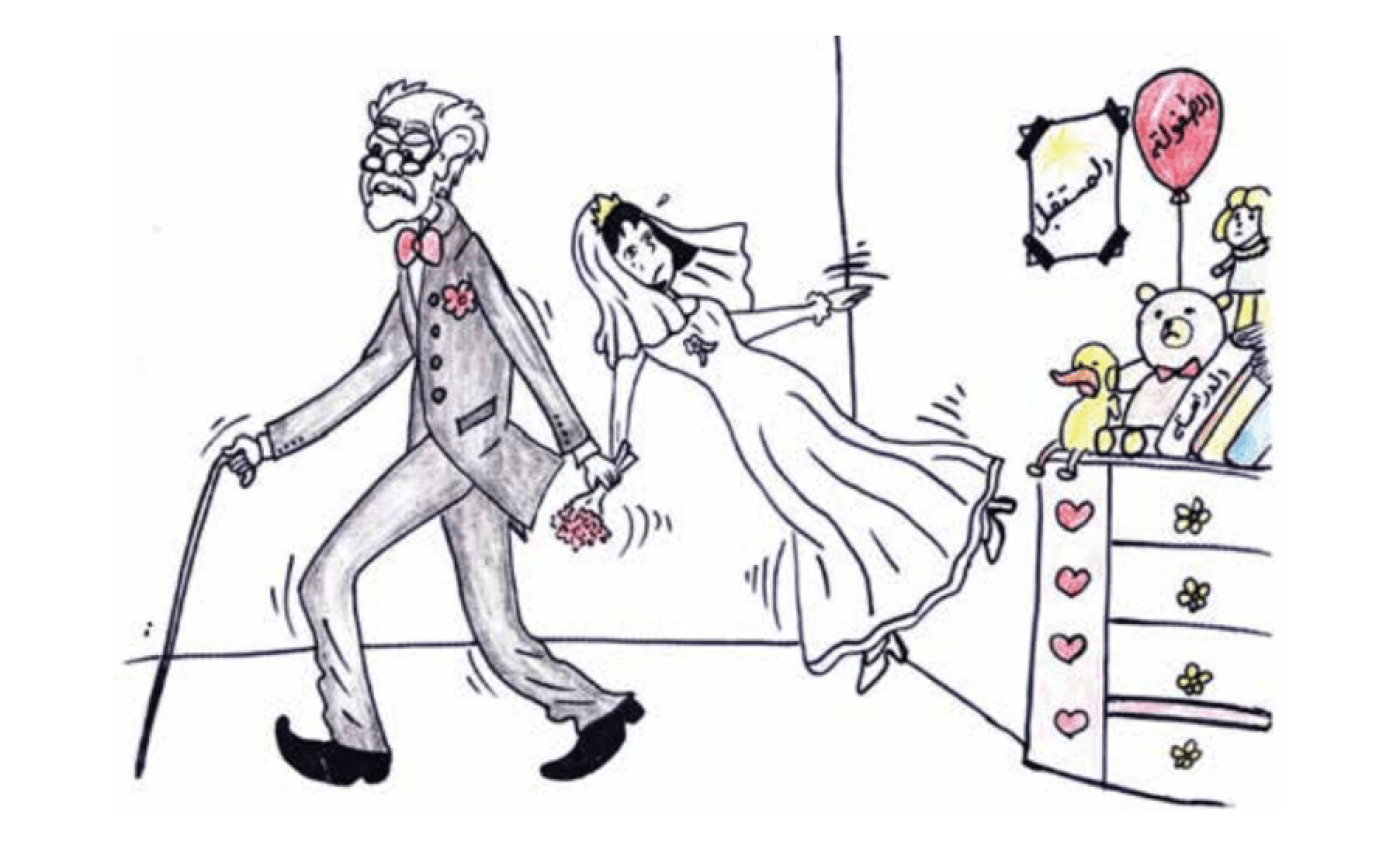
Media description
“The illustrations in this briefing are from a series of caricatures drawn by girls who attended sessions at a youth centre in Za’atari refugee camp.” (Save the Children, 2014, p. 3). This image demonstrates the solemnity of child marriage in humanitarian contexts.Blog content
By Renite Gosal, Refugees, Health and Humanitarian Action course student, SPS 2021-2022 academic year
For children all around the world, childhood should be an opportunity to learn and grow, with the freedom of having one’s whole life ahead of them. This, however, is not the case for the childhood of most Syrian refugee girls. After fleeing war and making the dangerous and often violent journey to a host country, young Syrian refugee girls in poverty are then confronted with the threat of child marriage, and the risk of religiously sanctioned “short-term” marriages. Such marriages come with the possibility of sexual coercion – not to mention, the risk of gender-based violence (GBV) is amplified more amongst married minors than adults. This has dire implications on the physical and mental health of displaced girls.
Confronting Temporary Child Marriages:
In 2013, the UN General Assembly created a standalone resolution to confront child marriage globally (Menz, 2016). This is the first time that the UN has recognised child marriage as an international issue. Despite this, child marriage remains very much a part of the lives of many young girls globally in 2022. Mut’ah marriages - defined as short-term “pleasure” marriages - are a phenomena occurring in refugee settings, including the Jordanian context. Pleasure marriages are illegal in Jordan, albeit they are religiously sanctioned and therefore permitted in many instances (Sidhva, 2022). While there are anecdotal arguments discussing the benefits and risks of such short-term marriages, there is minimal systematic evidence to support these arguments. This blog focuses on the health risks of such short-term marriages and calls for systematic evidence and awareness to be raised about the threat of temporary marriages involving refugee girls. In such contexts, wealthy men from various parts of the Middle East - commonly from Saudi Arabia - travel to countries such as Jordan to seek and marry young refugee children, often from Syria (Badran, 2019). They are married and can be taken by men for periods ranging from one day, weeks or even for as long as a month or months (Menz, 2016). The man often then annuls the marriage, abandons the girl, who may be pregnant due to unprotected sex, and returns her to her family. There is a vast research gap of such instances because the children from such temporary marriages are often stateless and thus illegal. Further, the sensitivity and secrecy of such short-term unions hinder research efforts.
Potential Drivers of Short-Term Marriages:
A plethora of factors enable such short-term marriages to be made possible. For instance, the magnitude of poverty and desperation in refugee families often forces young girls to be married off in exchange for money. Due to systemic biases in Jordanian law, many Syrian refugees have limited economic opportunities (Menz, 2016). For girls and women, there are even sparser opportunities, creating financial dependence on men. Due to these gendered economic realities, Syrian girls are susceptible to rich, older men paying their families for short-term marriages. Additionally, due to strong political relations between Jordan and Saudi Arabia, there is less of a likelihood of intervention from governments (Sidhva, 2022). Therefore, calls for humanitarian and NGO interventions are vital.
The Issue of Statelessness:
In addition to addressing child marriage as per the 2013 UN General Assembly resolution against child marriage, the issue of statelessness must also be addressed (Menz, 2016). Statelessness is the condition in which one has no legal status in any country, rendering an individual with little to no legal rights, and contravening the right to a nationality, as outlined in the Universal Declaration of Human Rights. This is a serious concern in terms of the quality of life of these children and subsequently their access to healthcare and rights. Without belonging to a state, one is relegated to a life in limbo, with healthcare needs like any other person, and no legal claim to such rights. Within pleasure marriages, girls are often forced to engage in unprotected sex without adequate contraception, and often become pregnant and give birth to stateless children after the dissolution of their marriages.
Health Impacts of Child Marriage, and GBV:
Girls who are subjected to short-term marriages may suffer from severe psychosocial and physical health problems. Further, there is no legal or social protection of these children from physical and sexual abuse within these marriages due to the secrecy and illegality of them. Thus, there are a multitude of health implications that can arise. These include risks of contraction of sexually transmitted diseases including HIV/AIDS, and adverse psychosocial effects of sexual coercion and violence, including PTSD, depression, hopelessness, and suicidality (Sidhva, 2022). In addition, premature pregnancy, particularly in girls ages fifteen to nineteen, increases instances of adversity during pregnancy and childbearing (Mourtada, 2017). The lives of these children and their fetuses are often at risk due to such sexual and physical violence, which can include physical tears due to forced penetration and sexual assault. We must ask ourselves, what is the future of stateless children birthed out of these unions founded on such severe violence and trauma?
Call to Action:
Despite the stark risks of religiously sanctioned temporary marriages, and the serious implications of statelessness, there is little available literature surrounding short-term marriages in the Jordanian context. To improve the health, well-being and lives of refugee girls, governments in host and surrounding countries must clamp down on illegal short-term marriages as well as child marriage. Every child deserves the right to experience a childhood free of sexual violence, the mental and physical health implications of sexual assault, child marriage and child pregnancies. How can we let such exploitative marriages steal the remaining childhood from already marginalised forced migrants? As host countries, we have the responsibility to protect young girls from such dismal futures.
References
Badran, & Turnbull, B. (2019). Contemporary Temporary Marriage: A Blog Analysis of First- hand Experiences. Journal of International Women’s Studies, 20(2), COV1Q–
Menz. (2016). Statelessness and Child Marriage as Intersectional Phenomena: Instability, Inequality, and the Role of the International Community. California Law Review, 104(2), 497 543. https://doi.org/10.15779/Z38ZC4H
Mourtada, Schlecht, J., & Dejong, J. (2017). A qualitative study exploring child marriage practices among Syrian conflict-affected populations in Lebanon. Conflict and Health, 11(Suppl 1), 27–27. https://doi.org/10.1186/s13031-017-0131-z
Save the Children. (2014). Too young to wed: The growing problem of child marriage among Syrian girls in Jordan. Save the Children's Resource Centre. Retrieved February 22, 2022, from https://resourcecentre.savethechildren.net/document/too-young-wed-growing-problem-child-marriage-among-syrian-girls-jordan/
Sidhva, D. (2022, February 9). Living with sexual and gender-based violence in urban refugee settings – evidence from Jordan
Spencer, R. A., J. Usta, A. Essaid, S. Shukri, Y. El-Gharaibeh, H. Abu-Taleb, N. Awwad, H. Nsour, Alianza por la Solidaridad, United Nations Population Fund-Lebanon and C. J. Clark (2015). Gender Based Violence Against Women and Girls Displaced by the Syrian Conflict in South Lebanon and North Jordan: Scope of Violence and Health Correlates, Alianza por la Solidaridad.