
Liberal Host Countries: the Illusion of Pinkwashed Safe Havens for LGBTQ+ Forced Migrants
Media
Image
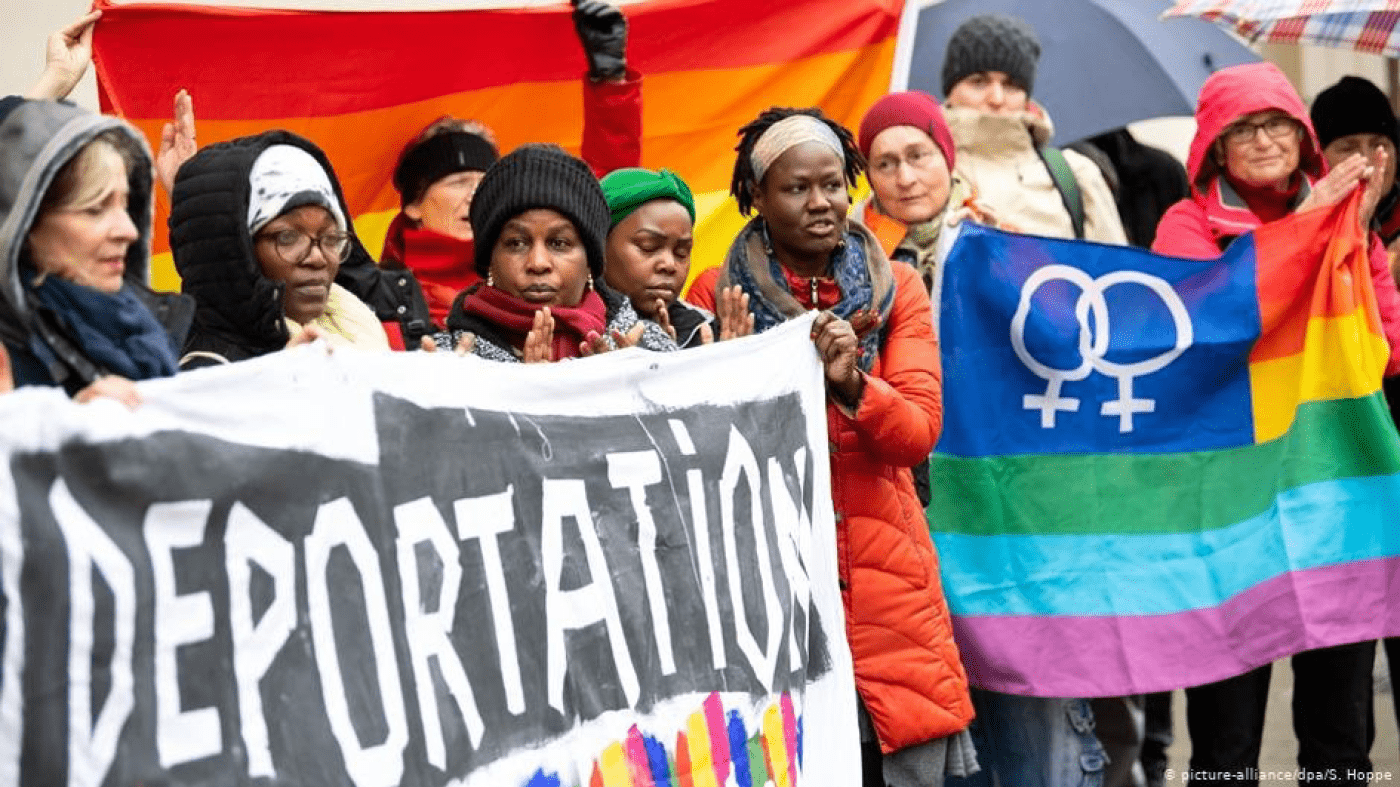
Media description
(Source: Deutsche Welle, 2020)Blog content
By Elise Delafontaine, Refugees, Health and Humanitarian Action course student, SPS 2021-2022 academic year
Advocating for LGBT+ people’s mental health is not time-bound to LGBT+ History Month. We must continue advocating for the mental health of those made invisible by sociopolitical and legal processes of exclusion. This is particularly true for forced migrants. Same-sex relationships are still criminalised in 69 countries (Burgess, Potock & Alessi, 2021). Some countries in the Global North, including Canada, the United States and members of the European Union, have recognized sexual orientation and gender identity as sources of persecution justifying asylum claims (Namer & Razum, 2018 ; Mulé, 2021). This understanding is aligned with the Geneva Convention 1951 which states that belonging to a social group supports asylum claims. This should open safe havens for LGBTQ+ people fleeing their countries because of gender discrimination, homophobia and transphobia. However, this is not enough to ensure safe processes of asylum. As advocates for forced migrants’ health, we must be vigilant to political pinkwashing.
Verifying Gender Identities and Sexual Orientations: The Western Gender Police, Another Actor in the Patrol of Borders
LGBTQ+ asylum seekers have to offer a convincing performance to get their application accepted (Namer & Razum, 2018 ; Golembe et al, 2020 ; Mulé, 2021). They don’t only have to claim they belong in the LGBTQ+ community, but they also must prove they fit into this normative categorization, abiding by Western expectations (Golembe et al, 2020 ; Heller, 2009).
« So, a gay person shouldn’t be very tough…[so] I left [the] gym. […] I left my happiness, what I want. » -Saad, a gay asylum seeker in Amsterdam (Alessi et al, 2018).
This leads to forced ‘coming out’ regardless of the psychological condition of the claimant (Kahn & Alessi, 2017). Asylum seekers can even be forced to detail their first same-sex sexual intercourse (Berg & Millbank, 2009). Not being able to produce a coherent narrative about sexual experiences, referring to their identity as a ‘problem’ or hesitations are used to discredit claimants’ statement (Berg & Millbank, 2009). The quality of ‘coming-out’ storytelling becomes the ultimate assessment to decide someone’s life trajectory. The paradox of this demand is striking as it denies the specificities of experiencing forced migration. How can one expect to be both a credible asylum seeker, adhering to expectations that ‘other’ the individual, and an LGBTQ+ individual responding to Western-based criteria? What’s more, how can we expect coherent narratives of coming out in court, and simultaneously reaffirm the expectation from applicants to have traumatic experiences associated to their identities? These contradictions highlight a distorted interpretation of the Geneva Convention where attention isn’t given to the experience of persecution against the asylum seeker, but diverted to asylum seekers’ behavior (Heller, 2009).
Mental Health Implications of Forced Sexualization of Life Narratives:
The pressure to provide a credible performance can be traumatising (Burgess, Potock & Alessi, 2021). The asylum seeking process exacerbates already present mental distress associated with the experiences of minorities, including internalized stigma, identity concealment and experiences of discrimination (Burgess, Potocky, Alessi, 2021 ; Golembe et al, 2020). By trying to perform the role assigned to them by state actors, LGBTQ+ migrants experience additional identity crises, trying to navigate the blurry lines of what’s acceptable (Kahn et al, 2017). This exacerbates pre-existing symptoms of PTSD, depression, loneliness and cultural bereavement (Hopkinson et al, 2016). Some studies have reported increased suicidality among those manipulating their identities to the asylum process (Burgess, Potock & Alessi, 2021). Experiences of sexual violence upon arrival further break the illusion of host countries as tolerant societies promising improved well-being (Alessi et al, 2018).
Opening the Floor to Intersectional Practices
It is not too much to ask for LGBTQ+ forced migrants to get access to inclusive health interventions. So far, intrusive questions by healthcare workers compounded by a lack of appropriate vocabulary reinforced by language barriers have refrained LGBTQ+ asylum seekers from receiving help (Kahn et al, 2018; Namer & Razum, 2018). Health workers should be trained on issues of confidentiality, cultural competency and gender (Golembe et al, 2020).
« I was in the hospital … and they refused to talk to me because I don’t speak German. […] Maybe they get confused because my gender in my documents and my personality isn’t the same. There it shows me as a man, but I am a female. » -an LGBTQ+ refugee in Germany (Golembe et al, 2020)
Studies have supported the need to systematize group therapy for LGBTQ+ forced migrants (Hopkinson et al, 2016; Reading & Rubin, 2011). This promotes the building of support networks and decreases the sense of isolation (Reading & Rubin, 2011). These approaches open new spaces for LGBTQ+ forced migrants to navigate the multiple layers of their identity safely . Interacting with peers is a protective factor which fosters resilience and social connection (Alessi, 2016; Namer & Razum, 2018), leading to new feelings of empowerment and pride.
Transformational health practices must concur with changes in immigration systems (Kahn et al, 2017). Only then can the UN’s Sustainable Development Goals numbers 3 and 5 about Good Health and Gender Equality be achieved. The 1951 Geneva Convention has been ratified to protect human rights. Universal legislative documents can be broadly interpreted. Hence, states’ practices can be arbitrary. Moreover, regional policies might create contradictions with international laws. For instance, the Dublin Regulation hampers asylum seekers’ decision-making in choosing their country of settlement. For LGBTQ+ forced migrants this might have serious health consequences (Alessi et al, 2018). Lina, a transgender woman who registered her fingerprints in Croatia before arriving in Austria, raises concerns about being forced to return to a country where affirming medical services are not available (Alessi et al, 2018). While discourses often portray forced migrants as ‘vectors of disease’, Western policy makers should look at themselves as the producers’ of forced migrants’ ill-health.
Reference List
Alessi, E. J. (2016) “Resilience in sexual and gender minority forced migrants: A qualitative exploration.,” Traumatology, 22(3), pp. 203–213. doi: 10.1037/trm0000077.
Alessi, E. J. et al. (2018) “A Qualitative Exploration of the Integration Experiences of LGBTQ Refugees Who Fled from the Middle East, North Africa, and Central and South Asia to Austria and the Netherlands,” Sexuality Research and Social Policy, 17(1), pp. 13–26. doi: 10.1007/s13178-018-0364-7.
Berg, L. and Millbank, J. (2009) “Constructing the Personal Narratives of Lesbian, Gay and Bisexual Asylum Claimants,” Journal of Refugee Studies, 22(2), pp. 195–223. doi: 10.1093/jrs/fep010.
Burgess, A., Potocky, M. and Alessi, E. (2021) “A Preliminary Framework for Understanding Suicide Risk in LGBTQ Refugees and Asylum Seekers,” Intervention, 19(2), p. 187. doi: 10.4103/intv.intv_5_21
Golembe, J. et al. (2020) “Experiences of Minority Stress and Mental Health Burdens of Newly Arrived LGBTQ* Refugees in Germany,” Sexuality Research and Social Policy. doi: 10.1007/s13178-020-00508-z.
Heller, P. (2009) “Challenges Facing LGBT Asylum-Seekers: The Role of Social Work in Correcting Oppressive Immigration Processes,” Journal of Gay & Lesbian Social Services, 21(2-3), pp. 294–308. doi: 10.1080/10538720902772246.
Hopkinson, R. A. et al. (2016) “Persecution Experiences and Mental Health of LGBT Asylum Seekers,” Journal of Homosexuality, 64(12), pp. 1650–1666. doi: 10.1080/00918369.2016.1253392.
Kahn, S. and Alessi, E. j (2017) “Coming Out Under the Gun: Exploring the Psychological Dimensions of Seeking Refugee Status for LGBT Claimants in Canada,” Journal of Refugee Studies, 31(1), pp. 22–41. doi: 10.1093/jrs/fex019.
Kahn, S. et al. (2017) “Promoting the wellbeing of lesbian, gay, bisexual and transgender forced migrants in Canada: providers’ perspectives,” Culture, Health & Sexuality, 19(10), pp. 1165–1179. doi: 10.1080/13691058.2017.1298843.
Kahn, S. et al. (2018) “Facilitating Mental Health Support for LGBT Forced Migrants: A Qualitative Inquiry,” Journal of Counseling & Development, 96(3), pp. 316–326. doi: 10.1002/jcad.12205.
Mulé, N. J. (2021) “Mental health issues and needs of LGBTQ+ asylum seekers, refugee claimants and refugees in Toronto, Canada,” Psychology & Sexuality, pp. 1–11. doi: 10.1080/19419899.2021.1913443.
Namer, Y. and Razum, O. (2018) “Access to Primary Care and Preventive Health Services of LGBTQ+ Migrants, Refugees, and Asylum Seekers,” SpringerBriefs in Public Health, pp. 43–55. doi: 10.1007/978-3-319-73630-3_5.
Reading, R. and Rubin, L. R. (2011) “Advocacy and empowerment: Group therapy for LGBT asylum seekers.,” Traumatology, 17(2), pp. 86–98. doi: 10.1177/1534765610395622.